"The sexual idea or value that I pursue in loving you cannot be possessed by possessing you: you are merely the medium through which it manifests itself to me. It transcends you. I want you, but you are not what I want."
Tuesday, September 24, 2013

Monday, November 21, 2011
Objects with Strong Symbolic Undertones
When thinking about what object to write about on my final essay, I started thinking of objects with deeper meanings. How can a can of soup epitomize an artistic movement? How can an apple pie portray the values of a nation? How can a website characterize a generation? In our society, everyday objects gain deeper meaning based on their connotation.
As i thought of these objects, I found a reoccurring theme of celebration. Confetti is thrown on new years, beads are used in Mardi Gras, balloons are the perfect party decoration and great for sending your congratulations and cake is a sweet treat for birthdays and wedding alike. However, out of all of the objects pertaining to celebration, I find fireworks to be the most iconic. Whether it be the Fourth of July, New years, the opening ceremony of the Olympic Games or the Superbowl halftime, fireworks not only captivate but dazzle audiences.
Fireworks, which were invented in 7th century china, come in all types: colorful, loud, big, small, bright, dull, smiley faces and stars . The brilliant colors in fireworks come from the burning metal compounds. vivid strontium forms a vivid red, calcium burns orange, sodium burns yellow, barium burns green, copper burns blue, cesium burns indigo, potassium/rubidium burn violet and iron burns gold. But the mechanics is not what makes them special. It is their symbolic meaning and history that sets them apart from party favors like balloons or cake.
In the novel, Kafka Was the Rage - A Greenwich Village Memoir, books have a strong symbolic undertone (like fireworks on the 4th of July). After World War II there was an obsession with the immersion of literature by the people of Greenwich Village. Books were so revered, "To open a bookshop is one of the persistent romances, like living off the land or sailing around the world." (page 28) When choosing an object for my research paper, it is vital to pick one with the same strength of symbolic undertones. Rubber ducks symbolize childhood and innocence and fireworks symbolize freedom, independence, nationality and pride. By choosing an object with deep societal meaning, I will not only have much more to write about, but it will make my essay more interesting and meaningful.
Kafka Was the Rage- A Greenwhich Village Memoir
Anatole Broyard’s novel Kafka Was the Rage- A Greenwich Village Memoir has a thought-provoking religious undertone. Sex is a central subject in the book, and just as soon as this topic is aroused religion is included. “ I was the only son of a Catholic family from the French Quarter in New Orleans, and no one is so sexually demented as the French bourgeoisie especially when you add a colonial twist” (pg. 9). I’m catholic and I would have thought that Catholics in the 1940’s would be much more firm in their religious convictions than what this statement suggests. This continues throughout the book. In the second part of the book on page 93, the topic of evangelical elements and redemption are considered and the author makes this comment “He was a type that was fairly common at the time but that seems to have gone out of style.” This is noteworthy because it seems that atheism has grown in the recent 10-12 years and that the percentage of atheists in the 1940s would be extremely low, and maybe look down upon. Furthermore author continually shows curiosity in Judaism. I think this book converses about many different universal and timeless topics.
This was just one stimulating statement that I read. “Education was chic and sexy in those days. It was not yet open to the public” (pg. 14). This was just mentioned on one page in the first part of the book but it really stood out to me. Sometimes I feel that education is open to the public but is still separated. Some students are able to receive a wonderful education because of their social status or the regions in which they live in, where as others are stuck in schools that are falling apart and aren’t able to receive the best education possible. I am not talking about college but about K-12, most importantly high school. In my high school I was only able to take 3 AP classes that was all that was offered. We did not have IB or whatever else there is. I know students who go to college with over 25 credits. I would love to have at least 8. My school was not a horrible school; but it did lack in areas because I am from a very small rural town. Subsequently I think that some high school and grade schools are more exclusive and give more opportunities to students based on area and sometimes income therefore it could be parallel to Broyard’s comment.
Sunday, November 20, 2011
Hipsterism...what does it mean?
I loved reading this book because it was so interesting and easy to relate to. The idea that stuck out to me the most was the idea of being a part of a counterculture. Personally, I have been called a hipster more than a couple of times in my life. Often because I dress differently and listen to "hipster" music. Either way I don't know how to respond to that accusation. Maybe I am, and maybe I'm not, but the definition is so unclear, and for some reason everyone looks down upon hipsters. I suppose it is because people think hipsters are trying so hard to be something different. I saw the same conflicting emotions from the main character in the book. He wanted to be a part of the underground scene in New York for the sole reason that he wanted to be different. In the second half of the book he went so far as to brag about himself to his new friends, just so he would fit in. I feel he did that because he liked the fact that it was exclusive and different. It allowed him to morph himself into that special, almost unobtainable sense of belonging. I think that's why people liked being in that community; it made them feel better and more interesting than their old self. This new sense of self is not appreciated by his parents, which is seen in the scene where Anatole's ex-girlfriend comes to his home. I think that "normal" people don't like the newness of that counterculture he was a part of. Maybe that is the reason why hipsters and the counterculture in the book aren't accepted is because they are taken as a threat to the normal way of life. They view themselves as above the majority of people because they are an exclusive minority, constantly trying to set themselves apart.
Ironic as it is, the minority grows as more and more people try to set themselves apart, thinking that they don't want to be a part of the majority of people. However, they try to fit in and change themselves and the process just becomes more and more ironic. This may also be another reason why the majority of people dislike countercultures. It can be seen with the hippies, the counterculture in the book, and hipsters today. These abstract people are seen as a threat to the normal way of life.
Thursday, November 10, 2011
When Real Life Meets Picture Books
Many children's books are a lot of fun to read, but have almost nothing to do with the real world. For example, Dr. Seuss's books have little grounding in reality. What on earth is a Star-Bellied Sneetch? And obviously cats can't talk and will not come knocking on your door. Many popular children's books are about things like puppies chasing lost balls and ducks crossing the street. These books are more realistic, but still don't tie in to real world problems.
And what's wrong with that? Absolutely nothing. Those kinds of children's books can be a lot of fun to read, and children can learn very basic morals from them : You shouldn't steal other people's things, you shouldn't make a mess that you can't clean up (what a great life lesson!), etc. Books that aren't grounded in any kind of reality can have worthwhile lessons as well.
But what really interests me are children's books that aren't fantasy, that address real-world types of problems. I don't mean like the Lorax, which addresses the real problem of saving the environment, but in a fantastical context. The book I read and wrote an analysis of this week was very grounded in the real world, which makes the ideas interesting for both children and adults. The book is called Zoo by Anthony Browne.
Zoo is fascinating because it's very simply about a boy's trip to the zoo with his family. To adults, it should be very clear what the book's morals are - basically, that humans treat animals in zoos badly - but to a child, these ideas probably seem much more subtle. The book's goal is to make kids more aware of a semi-controversial real-life issue : are zoos good for animals? Or do they do more harm than good? The book does this with very serious and sometimes slightly sad illustrations of animals in cages, mixed with more cartoonish images of people at the zoo staring at them, making fun of them, etc.
One thing that really made me sad was the way the young narrator mentioned that the polar bear at the zoo was pacing back and forth all day. This, to me, is a pretty clear sign that zoos aren't always good for animals, and I think Browne feels the same way. Many animals at zoos, like bears, wolves, and especially big cats, actually pace so much that they create worn out paths or trails in their enclosures. I think this is a sign that in captivity, these animals start to lose their mind a little. Being locked up really doesn't seem healthy for their mental states.
But I really do like that this book's morals involve real life. I'm not saying that people should write children's books about the Holocaust, but I do think it's important that children read both fantasy-type books and books about things in the real world, so that they grow up with a sense of what's going on around them. The question really comes down to how old children should be when books begin to introduce them to "real world" ideas, and what kinds of topics are just too serious for picture books.
Wednesday, November 9, 2011
A decline in the quality of children's books
We might have been reading children's books these past couple of weeks, but I've been reading children's books since the beginning of the school year. I've been tutoring a young kindergartner in reading and writing. It might seem pointless because she's only in kindergarten and she's not a native speaker. But in order to teach her to read, I've been reading many children's books to her aloud. One thing I've noticed is that the quality of children's books has been declining.
Back when I was little, children's books actually had stories. They were filled with a moral to the story or at least something poignant like a child finding her lost dog. But after reading children's books that are coming out recently, I've noticed that children's books today are not like that at all. They are more simple in plot with practically no meaning or life lesson. And they focus more on the visuals. Which might be a good thing, but the pictures tend to be simple, or disturbing. One children's book I read was called "Algernon Graeves is Scary Enough". The story is basically about a boy trying to find the perfect costume. Each page has the same lines: Algernon Graeves isn't scary enough! Paired with the words are disturbing pictures of ghosts, vampires, spiders, and such that grossed me out. But the girl I was tutoring simply smiled and read the book without much thought, and grabbed the next book. If I read her books like Dr. Seuss's "Oh the places we'll go", which actually have lots of meaning, she'll get bored.
This trend doesn't seem to be just in children's books though. T.V shows and music for kids are becoming less about learning lessons and more about mindless fun. I always hear people say "kids these days are becoming more and more twisted as they come". Could this be because our society is feeding kids with mindless books and media? When I was little, I would read stories about family, friendships, and love. Now the children's books I read are all focused on how some pictures change color and how some sparkle and some don't.
Monday, November 7, 2011
Visual Analysis or Summary?
When I first chose my children’s book, I thought it would be impossible to pull enough meaning out of the illustrations to write a whole paper. I flipped through Jamberry, one of my childhood favorites, and saw these simple and childish drawings of a boy and a bear frolicking through a land of berries. I didn’t think there was any way that the illustrator incorporated any hidden messages into his work.
It is extremely interesting to me that while I was looking for these hidden messages, the analysis was really right in front of me. I thought I was just giving a summary of the book, when I was actually analyzing the illustrations. It was hard for me to realize this because as a child I saw Jamberry as a story, but in reality the text does not tell a story at all, and this is where the analysis comes in.
While there are artistic techniques used in the illustrations such as color and physical space, the main focus is on the distance and space between the text and the illustrations. Because I was familiar with this story and as a child had it read to me, I saw the text and illustrations as one. But when I read the text on its own, I began to see that I was actually doing a visual analysis the whole time.
At the beginning I had such difficulty with this assignment because I couldn’t pinpoint many specific artistic components that tell a different message. However, I came to find that you don’t have to be an artist in order to do visual analysis. We visually analyze things everyday and that enhances our experiences. It is fascinating to think that as a child I was able to see the images in Jamberry as the narrative without putting any extra thought into doing so. Because the visual analysis paper is a college writing assignment, just that aspect can overwhelm you and block you from seeing that you actually know what you’re doing. Sometimes when you take a step back and think about what you are writing, your ideas may not be as obvious to others as you think they are, and what you thought was summary isn’t actually summary at all.
A Decline to Children's Books?
In the past two weeks or so in class, we have been talking about children’s books. Specifically, we’ve been analyzing the images and how they work to bring in new insight to the story and how they interact with the text. What we didn’t discuss was the impacts these books have on children. When looking through nytimes.com, I found an article that particularly shocked me. It said that children stories are becoming less and less prevalent in daily lives, as parents and teachers start to push “big- kid” books earlier. In fact, many publishers have reduced the amount of picture books that they publish.
After discussing picture books in class, I think it is absolutely necessary that children read these, even if they are also at a chapter- book level of reading. These books teach children to use their imagination and their creativity, something that is necessary to their development. It can begin a child’s path on developing their critical thinking skills, which are evidently much needed as their grow older and enter higher grades needing higher levels of thinking.
It will be interesting to see the implications of picture books in the future, with everything going on the iPad and less on actual printed works. Will picture books disappear completely? Will they not be used as prevalently in the classrooms? Will bedtime stories become a thing of the past? What do you guys think?
Monday, October 24, 2011
Michigan Wild Things
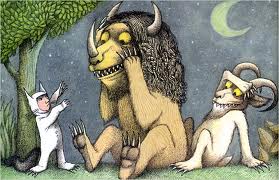
When I first came to college I could relate to Max. I was in this new environment and everything around me seemed new and foreign. My old dwelling and surroundings turned into this “forest” over night. I had no mom telling me to clean my room, to shower, or to eat healthy. I came to this forest and found myself surrounded by wild things! Scary lecture classes with three hundred plus students, a meal plan i quite didn’t understand, clubs I don’t know how to join because I get bombarded with too many emails, and people who I’ve never met in my life. I was completely torn out of my bubble and thrust into the midst of the wild. The teachers showed me “their terrible roars” with essays and midterms, and these strange peers showed “their terrible claws” and worked harder and played harder than any other kids I know. In the story Max was able to tame these wild things and become the king. It’s hard coming to college and hard to adapt to all these new strange things around us, but, as max teaches us, “if you surrender to the wind, you can ride it.” If we accept that we have to write essays, accept that we are going to have to eventually meet new people, and accept that a class of three hundred is no big deal we can succeed. It took some time to adopt this mentality at first because it seems like you are succumbing to peer-pressure and just trying to conform instead of being unique. In reality you are just accepting the way things are and learning how to survive in this jungle. The best part of this book is that no matter where I am, I know I can always go back home to a loving family like max came back to find his supper waiting for him.
Sunday, October 23, 2011
Close Looking at the UMMA
Our past few class assignments have made me think about an interesting question for all of us to consider: What makes a "good" interpretation? Close looking and reading breaks down large images and texts to scrutinize every possible detail in order to support an idea. The key word that Sendak focuses on is "interpretation". Interpretation makes up the foundation of what we call the humanities--where there is more than one right answer to every question, and each and every point of view can yield a different conclusion. Hence, an objective critique of one's subjective interpretation cannot be based on that interpretation, but rather on one's ability to support their ideas with significant and relevant evidence.
As I stared at the sculpture that I chose to focus on last week it didn't take long for me to realize that it will be impossible to ever know what this piece really means without consulting its creator. I felt like I was cheating when, after a few minutes of blankly staring at the elegantly welded hodgepodge of semi-human metal body parts, I peeked at the placard set of to the side. The placard mentioned a few names, dates and places--all unfamiliar to me--and then it discussed the meanings that some art historian assigned to a few regions of the piece. I immediately began to disagree with the historian's conclusions. The placard never explained why these assumptions would be true, and I had no specific knowledge with which to validate them. Apart from being credited as a professional in this field, I had no reason to consider his assumption more or less valid than mine.
This whole situation reminds me of a great quote I found on the internet (of all places):
In the context of Abraham Lincoln quotes, this example is obviously fabricated, but when it comes down to a literary or visual analysis of a work, understanding which interpretations are reliable can be quite difficult. What it comes down to is one's ability to support an opinion. That is where I feel specific knowledge comes into play. Knowing close to nothing about cubism or metalwork from the late 30's, perhaps it would be difficult to support my opinion. But, just the same, anyone else's opinion is only as strong as the evidence that supports it.
What Is Art?
In my high school English class we did a group project revolving around the question “what is art?” The word “art” seems so commonplace, but try to stick a definition to it—it’s a lot tougher than you might think.
For one part of this project my group members and I walked around downtown interviewing random people and asking for their interpretation of the word “art.” One man claimed that “art is making something out of nothing and making money off of it.” A second man said that “art is drawings and designs.” And a lady claimed that “it’s a form of expression that goes beyond words.”
I found it interesting that when we asked the question, “what is art?” seven out the ten people interviewed implied that art is solely visual, four claimed that art involves a career or income, and four additional interviewees (not included in the ten used for the project) could not even answer the question.
Perhaps we were asking a trick question though. Does art really have a set definition? Depending on the perspective, art can range from literature, to paintings/ drawings, to dance and music, to fashion, to architecture, and so far beyond.
Wikipedia claims that “art is the product or process of deliberately arranging items (often with symbolic significance) in a way that influences and affects one or more of the senses, emotions, and intellect.” While this may be one of the better definitions I’ve come across so far, I still notice a couple of flaws. My first problem with this definition is that many artists do not do things deliberately. Some let the paint drip, some smash and overlap objects randomly until they’re satisfied with the appearance--a lot of times art is accidental, not deliberate. This definition also implies that something considered to be art to one person may not be considered art to another. But does this mean that if one person’s emotions, sense or intellect are not affected by a certain painting he can say that it’s not art, even if someone else thinks it is?
Our visit to the art museum raised this question in me. As we stood in front of the first abstract painting where Mark introduced us to art analysis, I overheard someone say “that’s not art, I could do that.” And I think that fosters an interesting conversation…
Protecting Children
As I read "An Interview with Maurice Sendak," his thoughts on the exposure of children to the media really struck a chord with me. Growing up, I wasn't allowed to watch TV or listen to popular music or see movies because it was part of the curriculum of my school - the point was to keep the innocence of childhood for as long as possible. As far as I can tell, it worked. Kids at my school spent their time creating things, exploring and learning. We weren't even given homework until 5th grade, so preserving our childhood innocence and curiosity was really a primary goal of my elementary school. When Sendak mentioned how he thought it was ridiculous that we try to control what children read, and that only books that "follow the course of what a childhood specialist considers right" are okay, it really prompted me to think about how much media children are exposed to today. I don't know about you guys, but it really frightens me when I see a first grade girl wearing a sexy outfit singing Britney Spears. I think Sendak brings up a good point, from the perspective of a picture book author, that what children read should really be the last of our concerns. With how the media permeates our lives on an every day basis, it seems like letting a child read what he or she wants isn't something we should be scared of. If anything, a child who wants to read at all in our current media-controlled society is something that should be encouraged. What do you guys think? Should we be scared of what children can read? Or does the issue lie more with controlling what children can see and hear in the media?
Monday, October 3, 2011
Daydream Believer
I would just like to preface my comments by saying that I am absolutely loving this book! I am so mad at myself for not listening to all my friends when they told me to read it all throughout high school. The way that Sylvia Plath writes is incredibly captivating and immediately draws me into the story. I feel for Esther, her anger and disappointment at Buddy Willard, and her feelings of having a stunted sense of direction. Who among us has never felt the emotions she has? Disappointment in a peer? Check. No clue what to do with your life? Check. Third wheel to a couple? Check. It happens to all of us. She weaves a story of such detail and description that even if I did not know that this book is semi-autobiographical, I would have guess that she poured her heart and soul into it.
For my blog post I would like to address a single sentence from the seven chapters we had to read.
"I wanted to crawl in between those black lines of print the way you crawl through a fence, and go to sleep under that beautiful big green fig tree" (Plath 55).
The moment I read this sentence, my heart surged with the recognition of a kindred soul. I consider myself to be an avid reader, whether it be The Help, Harry Potter, or The Catcher in the Rye, I'll read it all. And I cannot count the number of times I have finished reading a book only to want to spread it open and swan dive into the text. To become best friends with the characters I've fallen in love with and mess around with them throughout their adventures is my goal. What I wouldn't give to explore Redwall Abbey with Matthias, contemplate the American Dream with Nick Carraway, or pal around in Maycomb, Alabama with my two favorite characters of all time, Scout and Jem. Although, these are simply the wishes of an adolescent daydreamer, I shall continue to let my mind wander, for the possibilities of the impossible are endless.
For my blog post I would like to address a single sentence from the seven chapters we had to read.
"I wanted to crawl in between those black lines of print the way you crawl through a fence, and go to sleep under that beautiful big green fig tree" (Plath 55).
The moment I read this sentence, my heart surged with the recognition of a kindred soul. I consider myself to be an avid reader, whether it be The Help, Harry Potter, or The Catcher in the Rye, I'll read it all. And I cannot count the number of times I have finished reading a book only to want to spread it open and swan dive into the text. To become best friends with the characters I've fallen in love with and mess around with them throughout their adventures is my goal. What I wouldn't give to explore Redwall Abbey with Matthias, contemplate the American Dream with Nick Carraway, or pal around in Maycomb, Alabama with my two favorite characters of all time, Scout and Jem. Although, these are simply the wishes of an adolescent daydreamer, I shall continue to let my mind wander, for the possibilities of the impossible are endless.
Sunday, October 2, 2011
Image of Purity and Whiteness in The Bell Jar
Has anyone read a book where the image of certain colors appears so many times he can't help but notice them? For example, I've read a couple books where the color red comes up several times, and accordingly, it symbolized Communism.
Well in this book, for chapters one through seven, I've notice the color white a couple dozen times, at least once a page. I'm sure everyone here too has noticed it. Here are a couple notes I have written to try and understand the purpose/ meaning of this:
1) We all know that white typically symbolizes purity and innocence and goodness (for lack of a better word),
a) (The word "pure" is also repeated several times)
2) however, the color white has some pretty negative associations, which is the opposite of white should do.
a) For Esther, white symbolizes a taint in this idea of purity. She believed Buddy to be pure and a virgin, and to be a wholly honest person. However, when she discovers his affair, not only is this idea innocence lost because she discovers he's not a virgin, she also loses her trust in him.
i)Notice how this happened after the baby was born, as Esther described. Babies being born should symbolize new life and purity, but for Esther, she associates this with Buddy's loss of innocence. She also describes the birth to look like torture, and to Esther, "whiteness" is a sort of torture because of what she associates it with.
ii) Also, Buddy had "white teeth" and a "white turtle neck."
b) Another bad association that I discovered is when she became ill from the crabmeat. This theory of mine is a little more far-fetched than the above one and a little harder to recognize, but I think it is plausible and relevant to the book. At this point in the book, there again are very many uses of the word "white." Also notice that what made her sick was the crabmeat, which was made with mayonnaise, which is white. Something about whiteness is not good for Esther. Crab meat is also is a symbol of wealth, because only the rich people eat it. We discussed on Wednesday that Esther is not very fond of this idea of wealth. Altogether, she has a "bad taste in her mouth" about wealth, which is associated with white,
i)and the reason I say wealth is associated with white is because many of the wealthier other women are described with images of whiteness. page 10 "[Doreen had] white hair and white dress she was so white she looked silver."
ii) There is also darkness to the whiteness and silver, as shown in this quote: "The same silver glow on them at the front and the same black shadow on the back of them." There are other examples of this too. ". . . stiff blond hair fell from [Doreen's] dark roots." This happened right after she was drinking and threw up in the hotel.
So I don't know. I could be right, I could be wrong. To me, it seems like something is going on with this "white" and "purity" and wealth thing. Are my outlined ideas far-fetched? or do you guys agree with me? What do you think?
The Bell Jar
Sylvia Plath's first chapter of The Bell Jar, which we read as a class, is definitely one of the most striking and intriguing first impressions that I've ever read. In her first paragraph, she considers the idea of being executed and being "burned alive." I, who have yet to find a passion for reading, was immediately intrigued. I wondered, is this what it takes to secure the reader's interest? Is it more or less vital to begin your novel off in a shocking, odd, or even controversial anecdote? I'm sure that for many other readers out there, introductions may be given some leigh-way in terms of how interesting they are. But for readers like me, who could live without reading books, I think that a different yet interesting introduction is really necessary in order to grab the reader's attention and make sure that they are truly enthralled and interested in every line that you write.
There is definitely something fresh about her writing, though. From her frequent descriptions of what her true steam of thoughts are, to her perfectly accurate descriptions of New York, Plath's writing really captures my attention. Her constant focus on death, of some sort or another, did raise my attention because she killed herself not too long after the book was published. Now, looking back on it and knowing that she did take her own life, it leaves the novel with an eerie vibe (in my opinion) that may, actually, help make certain circumstances in the book that much more dramatic and intense.
Friday, September 30, 2011
David Foster Wallace Commencement Address
David Foster Wallace’s commencement address conveyed a message that seems to be quite simple, but is actually extremely complex. Wallace talks about how to approach daily life, and the different spins each individual can put on every situation.
He discusses a time in his life when was in line at the grocery store after a long day at work, and couldn’t help but be annoyed with every move anyone made around him. He states, “you get told to "Have a nice day" in a voice that is the absolute voice of death. Then you have to take your creepy, flimsy, plastic bags of groceries in your cart with the one crazy wheel that pulls maddeningly to the left, all the way out through the crowded, bumpy, littery parking lot.” After describing this way of approaching life, Wallace discusses a different outlook: one that forces you to be thankful for what you have and realize that the people around you probably have it much worse. Everyone discusses and pretends to embrace this message countless numbers of times, but in the heat of the moment it is very difficult to actually believe and acknowledge it. Wallace discusses how a liberal arts education is what allows you to have to skills to recognize this message if you want to, and to ignore it if you don’t. This is extremely profound and true, but also hard to recognize in the heat of the moment.
Reading Wallace’s speech made me think about the way I approach my own life, and the way I communicate with the people around me. It is always important to realize that someone else is in a harder situation than your own, and it is never worth it to let the little things in life effect you more than they should.
Monday, September 19, 2011
Art Is My Savior
Poetry Can Save You
Ever since reading “Full of It” that’s the phrase that’s been stuck in my head. Its not that I have never felt that way but I have never seen a phrase I believe in more whole heartedly. After reading “I Thought You Were a Poet” I believe in it even more because while many poets may be psychotic, it’s their art that saves them. I guess I will always be able to identify with poets because I have had my share of “behavioral health” problems, and something about being in a dark place mentally is very poetic. Feeling the highest highs and lowest lows really opens up the world and though it might be painful it’s extremely beautiful.
I have personally never enjoyed the idea of saving someone or being saved. However, the idea of art saving someone is extremely appealing. To throw all your pain and madness into an art form and out of that create something beautiful amazes me. Doing so makes perfect sense because any kind of art is an outlet for feelings that may not be normal or acceptable, but are a part of you all the same. In a sense I suppose madness appeals to me because of the inspiration it can cause, but I only support productive madness, not the kind that leaves you bedridden. Productive crazy people tend to be more interesting than “normal” people and seem to have better taste in books and music. I guess like Kerouac said “the only ones for me are the mad ones.”
Subscribe to:
Posts (Atom)